
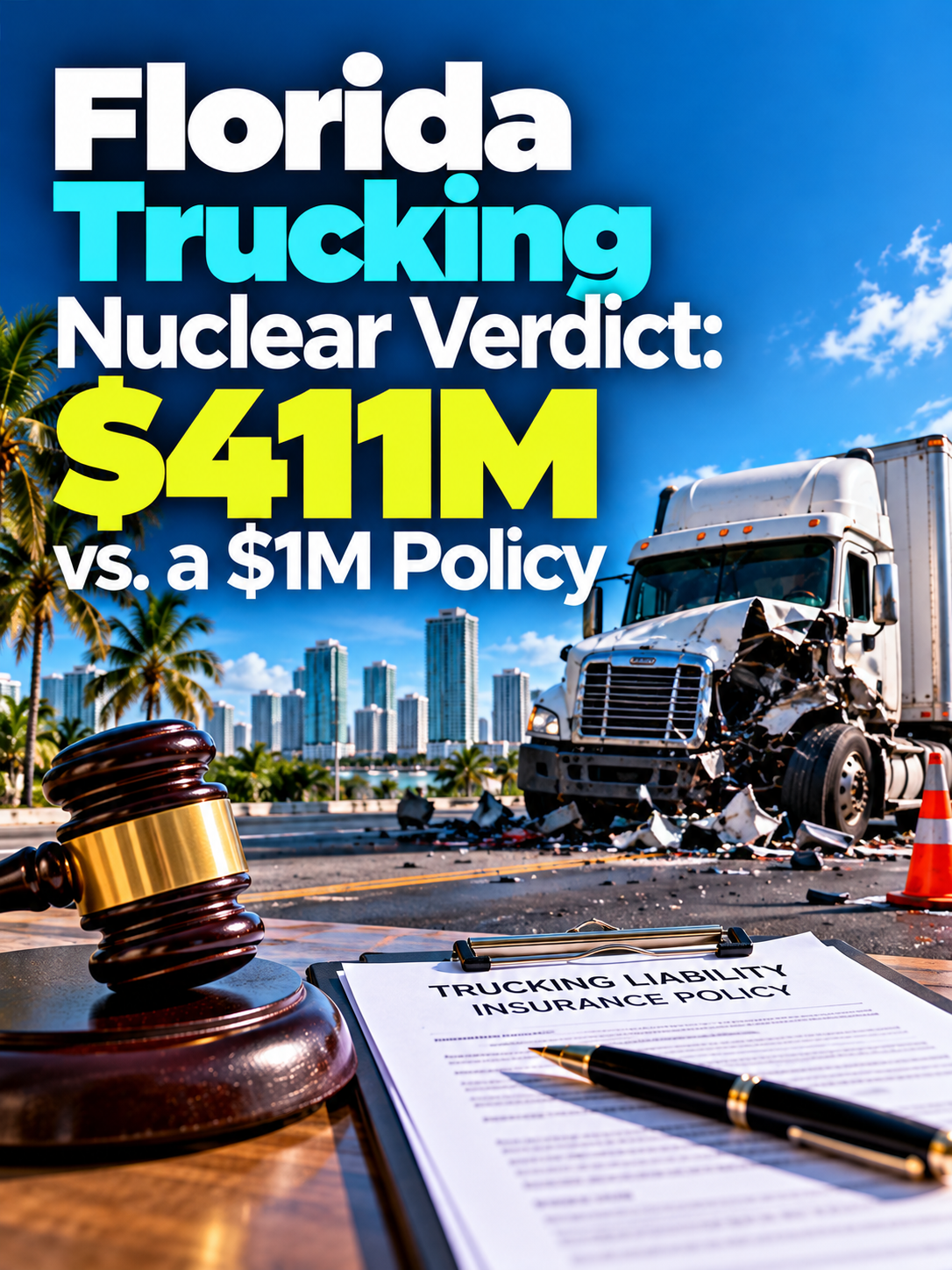
Quick answer: In October 2020, a Florida jury returned a $411,726,608 verdict against a single-truck company in a 45-vehicle highway pileup. The company reportedly offered only $1 million, which is consistent with a policy limit, and the primary insurer later settled for that $1 million limit. The lesson for Florida businesses is that commercial auto insurance limits that look adequate on paper can fall far short when a catastrophic injury claim reaches a jury.
What happened in the Florida trucking case
The claim traces back to a 2018 multi-vehicle pileup on a Florida highway involving 45 vehicles and 18 separate crashes. According to FreightWaves reporting, a semi-truck operated by Top Auto Express, a one-truck company based in Pembroke Pines, jackknifed and set off a chain of collisions. A motorcyclist, Duane Washington, swerved to avoid the wreck, struck a stopped truck parked without lights in the emergency lane, and suffered devastating, permanent injuries.
The case was tried over Zoom, and on October 6, 2020 the jury awarded $411,726,608. Industry coverage at the time described it as one of the largest trucking verdicts ever recorded in Florida. Later trade reporting by Insurance Insider noted that the primary commercial auto carrier settled for its $1 million policy limit and that the insured did not appear in court.
Why a “nuclear verdict” matters to every Florida business
A nuclear verdict is generally a jury award above $10 million. Most Florida businesses do not run 18-wheelers, but the same exposure applies to anyone who puts vehicles on the road: contractors with pickups and box trucks, delivery fleets, property managers, restaurants with catering vans, and companies whose employees drive their own cars on company errands.
Three realities make the risk real:
- Policy limits are a ceiling, not a shield. Once a judgment exceeds your coverage, the plaintiff can pursue company assets, and in some structures the owners.
- Federal minimums are low. The FMCSA minimum financial responsibility for most for-hire general freight carriers is $750,000. That figure was set decades ago and is far below the cost of a serious injury claim today.
- Collectability does not protect the defendant’s reputation or operations. Even when a verdict is practically uncollectable, the company may lose its operating authority, its contracts, and its ability to get insured again.
How much commercial auto liability does a Florida business need?
There is no single right answer, but a useful starting point is to match your limits to the severity of claims your operations could realistically cause, not to the minimum a customer contract or state rule requires. A $1 million combined single limit is a common baseline. For businesses with heavy vehicles, frequent highway driving, or employees traveling to job sites, many risk managers recommend layering a commercial umbrella or excess liability policy on top of the primary auto policy.
We covered the basics of this exposure in How Low Auto Insurance Limits Can Bankrupt Your Business. The Florida case above shows the same principle at a far larger scale.
Florida’s legal climate and what changed
This verdict came before Florida’s 2023 tort reform (HB 837), which changed the state’s negligence rules, including moving to a modified comparative negligence standard and shortening the filing window for most negligence claims. Those changes were meant to reduce litigation and runaway awards, and early market commentary suggests general liability pressure has eased in some areas. Even so, catastrophic-injury trucking cases remain among the most expensive claims in the casualty market, and underwriters continue to scrutinize commercial auto accounts closely. For a broader view of where the market stands, see our overview of Florida commercial insurance trends in 2026.
Action steps for Florida business owners
- Review your liability limits. Confirm the combined single limit on every commercial auto policy and compare it to your worst realistic loss.
- Add umbrella or excess coverage. Ask whether your umbrella sits over auto, general liability, and employer’s liability, and whether it has exclusions for certain vehicles or drivers.
- Cover hired and non-owned auto. Employees driving personal vehicles for work and rented vehicles are a common gap.
- Vet drivers and contractors. Run motor vehicle records, set a written driver policy, and require certificates of insurance from subcontractors who drive for you.
- Invest in telematics and dash cameras. Video evidence helps defend claims and can improve underwriting terms.
- Report claims early and cooperate. In this case the insured never appeared in court, a decision that can leave a business exposed even when it carries coverage.
Frequently asked questions
What is a nuclear verdict in Florida?
A nuclear verdict is a jury award that far exceeds expected damages, typically above $10 million. They are most common in trucking, premises liability, and product liability cases.
What happens if a judgment exceeds my commercial auto policy limit?
The insurer pays up to the limit, and the remaining judgment is the defendant’s responsibility. Excess or umbrella liability insurance is designed to pay above the primary limit.
Does a small Florida business need commercial auto insurance?
Yes. A personal auto policy generally excludes vehicles used for business purposes. Any vehicle used to carry goods, tools, or customers for the business should be on a commercial auto policy.
Is umbrella insurance worth it for Florida businesses?
For most businesses with vehicles, employees, or public-facing operations, umbrella coverage is a relatively low-cost way to add $1 million to $10 million or more in liability protection.
Talk to a Florida commercial insurance advisor
If you are not sure your auto, umbrella, and general liability limits would hold up after a serious accident, the team at Highlight Risk Services can review your program. Contact us for a coverage review, or browse more guidance on our insurance blog.
This article is for general educational purposes and is not legal advice. Case details are drawn from public reporting and may be incomplete; coverage decisions should be reviewed with a licensed insurance professional.